Dog Harness vs Collar: What Vets and Trainers Recommend
Aysire Editorial
Share
Every guide says the same thing: harnesses spread pressure, so buy one. Two of the four questions people actually ask are about why trainers disagree.
1053 words,
5 minutes read time.
Last edited .
Ask the internet whether to use a harness or a collar and you get one answer, repeated. Harnesses spread pressure, collars concentrate it on the neck, so buy a harness. It is true as far as it goes.
It also does not match what people are actually typing. Two of the four questions Google lists under this search are about the other side of the argument: why some trainers dislike harnesses, and what the disadvantages are. Almost nothing on the first page answers either one.
What a Harness Actually Changes
The mechanical case is real and worth stating once. A collar concentrates every pull onto a two inch band over the windpipe; a harness spreads it across the chest.
For a dog that lunges, that difference is the whole argument. Repeated pressure on the trachea is linked to coughing, and in small breeds with narrow airways it is linked to worse than coughing. If your dog hits the end of the leash regularly, the neck is carrying loads it was not built for.
Do Vets Recommend Collars or Harnesses?
Broadly, vets favor harnesses, and they are answering a health question. Flat faced breeds, small dogs with fragile windpipes, and any dog with a diagnosed airway or neck problem come up most often.
That is not the same as saying a collar has no job. A collar carries identification, and identification is the thing that gets a lost dog home. Many US cities and counties require a visible license tag on a dog in public, and a harness that comes off after the walk cannot carry one.
Most dogs need both: a collar that stays on for identification, and a harness that goes on for the walk. Treating it as a choice between two products is where the question goes wrong.
Why Some Trainers Do Not Like Harnesses
Here is the part the buying guides skip, and it is not a mystery. A standard harness clips at the back, between the shoulder blades. That gives a dog a solid, comfortable point to lean into.
Dogs have an opposition reflex: push against them and they push back. A back clip harness turns a pulling dog into a well supported pulling dog, and pulling that feels good gets repeated.
A back clip harness is the design sled dogs wear, which is odd gear for a dog you want to stop pulling.
Trainers also point out that a collar gives clearer directional information. A small movement at the neck is felt immediately; the same movement at the back of a harness is absorbed by webbing before it reaches the dog. Neither of those makes harnesses wrong. They make the back clip the wrong default for a dog with a pulling habit, and a front clip the right one.
The Real Disadvantages of a Harness
Set against the pressure benefit, honestly:
It can encourage pulling, for the reason above, unless the clip is at the front.
It rubs behind the front legs when the fit is wrong, and the rub shows up as a bald patch weeks later.
It takes longer to put on, and many dogs dislike anything going over the head.
It gives you less leverage on a large strong dog, not more, which surprises people.
It comes off between walks, so it cannot carry a tag.
Fit is the variable sitting behind most of that list. A harness should take two flat fingers underneath any strap and no more, and the chest piece should sit clear of the armpit rather than pressing into it. One that passes both checks rubs nothing; one that fails either will find the same spot every single walk.
The over the head problem has a straightforward fix. A step in harness is buckled on the back after the dog has walked into it, so nothing passes near the face at all. For a dog that ducks away from being dressed, that single design difference decides whether walks start calmly.
Small Dogs, Large Dogs and Dogs That Pull
The right answer changes with the dog, which is why the blanket advice satisfies nobody.
Small dogs sit closest to a clear recommendation. Narrow airways and light bodies mean a lunge on a collar carries real risk, and a harness is almost always the safer default for daily walking.
Large dogs are the case where the internet oversimplifies. A harness is kinder to the dog and gives the handler less control, not more, because you are attached to the strongest part of the animal. With eighty pounds on the other end that matters, and it is the one case where a collar keeps a job on the walk itself.
For dogs that pull, a front clip turns the dog toward you instead of letting it lean forward. That buys you calmer walks from the very first outing while the training does the deeper work.
What to Own if You Buy One Thing
A collar that lives on the dog with a tag, and a harness that goes on for walks, covers almost every household. If the budget allows only one purchase today and the dog already has a collar, buy the harness.
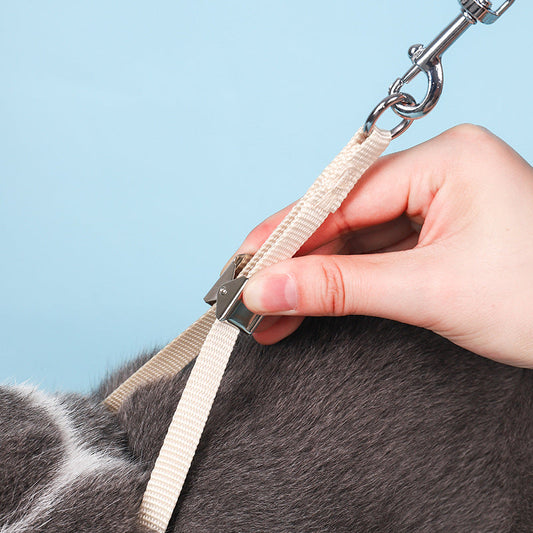
Two details are worth more attention than the color. Hardware fails before webbing does, so a solid brass clip outlasts a plated one that corrodes at the spring. And a soft cotton rope leash spreads the shock of a sudden lunge across your whole hand rather than into one finger, which you will notice on the first squirrel.
The harnesses, leashes and collars here are sold as matched sets dyed in a single batch, so the two pieces actually agree rather than nearly agreeing.
The Question Behind the Question
Nobody searching this is really asking which product is better. They are asking whether they are hurting their dog, and whether the walk can be less of a fight.
A well fitted collar with a tag answers the first question for a dog that already walks calmly. A harness answers it for every other dog, and answers the second at the same time by taking the argument out of the animal's throat. Put the collar on for the tag, the harness on for the walk, clip at the front if there is pulling, and the next walk is quieter than the last one.
Every guide solves the filler. Rice, pasta, cloud dough. What almost none of them covers is the part that decides whether a bin holds a toddler: what you bury in...
Every guide solves the filler. Rice, pasta, cloud dough. What almost none of them covers is the part that decides whether a bin holds a toddler: what you bury in...
The school year ends, the days lose their shape, and devices quietly fill the gap. Very few parents choose this; it simply happens because reaching for a screen is easier...
The school year ends, the days lose their shape, and devices quietly fill the gap. Very few parents choose this; it simply happens because reaching for a screen is easier...